
Livestock
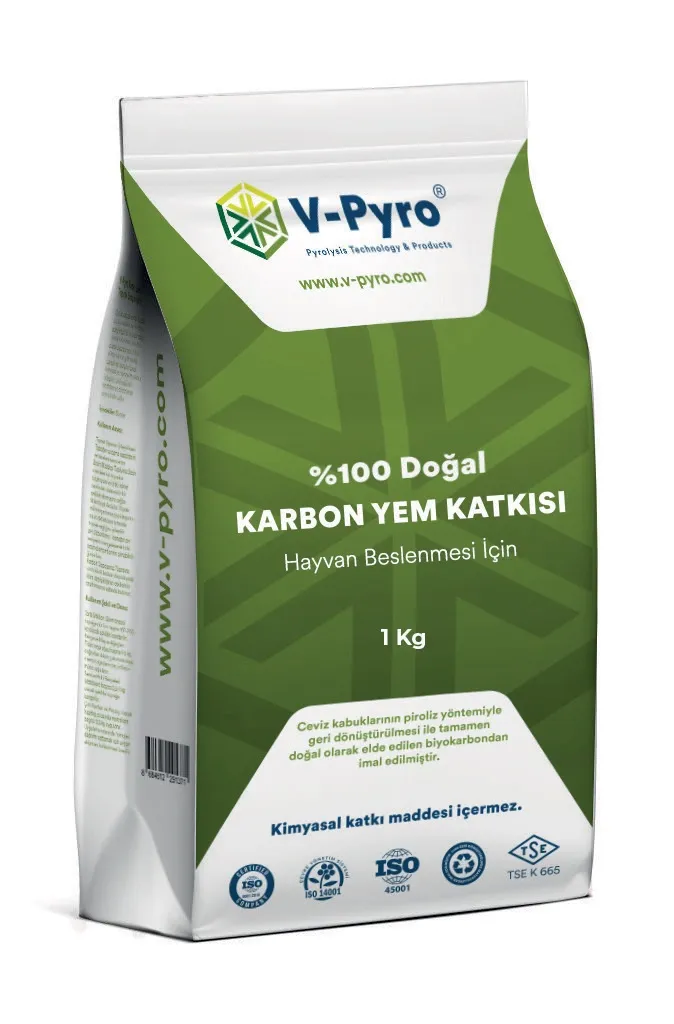
KARBOVITAL Carbon Feed Additive
Biochar for animal nutrition
Produced through the pyrolysis of olive pits, walnut shells and apricot kernels, this biochar is specifically designed to be used as a feed additive for animals.
- 0.2% – 1%Share of the daily feed ration
- 100%Natural; contains no chemical additives
- 3Animal groups: large ruminants, small ruminants, poultry
What is KARBOVITAL Carbon Feed Additive?
KARBOVITAL Carbon Feed Additive is a biochar product made by pyrolysing olive pits, walnut shells and apricot kernels and designed for use in animal feed. Its porous structure supports the digestive system, improves nutrient absorption and binds harmful substances such as mycotoxins. It is added to the daily feed ration of large and small ruminants and poultry.
Supports digestion and optimises nutrient absorption.
Thanks to its suitable surface area and porosity, it supports the digestive system, optimises nutrient absorption and helps retain pathogens present in feed.
Digestive system
Helps regulate the digestive system.
Nutrient absorption
Enhances the absorption of nutrients.
Health and performance
Supports animal health by adsorbing pathogens in feed; improves overall animal health and performance.
Microporous carbon that binds harmful substances.
Biochar is a carbon-rich material produced by pyrolysis. Thanks to its microporous structure it acts as a toxin binder in the digestive system, trapping harmful substances such as mycotoxins and heavy metals; it balances the gut flora and reduces pathogen pressure. It improves the feed conversion rate and lowers ammonia in faeces, reducing odour and environmental pollution. Even at low doses, biochar can have a significant biological effect when used as a feed additive. This product contains biochar whose carbon sequestration effect has been proven according to international standards; carbon credits are separate from the physical product.
- Structure
- Microporous carbon
- Binds
- Mycotoxins · heavy metals
- Reduces
- Ammonia and odour in faeces
- Feedstock
- Olive pits, walnut shells, apricot kernels
Between 0.2% and 1% of the daily feed ration.
Rates are given per animal group, as a percentage of the daily feed ration.
| Application | Rate | Frequency | Source |
|---|---|---|---|
| Large ruminantsCattle, buffalo · added to the feed rationFeed additive | 0.5% – 1% | Daily | Manufacturer's recommendation |
| Small ruminantsSheep, goats · added to the feed rationFeed additive | 0.5% | Daily | Manufacturer's recommendation |
| PoultryChickens, turkeys · added to the feed rationFeed additive | 0.2% – 0.5% | Daily | Manufacturer's recommendation |
These rates are general recommendations and do not replace a veterinarian's or feed specialist's ration advice.
Into the daily feed ration, by animal group.
- 01
Choose the rate
Take the rate for your animal group from the Dose–Effect tab.
- 02
Calculate the amount
Calculate the amount from the weight of the daily feed ration; for example, 0.5% of a 10 kg ration is 50 g.
- 03
Add to the ration
Add the calculated amount to the daily feed ration.
Safety information
- Signal word
- Warning
- Hazard statements
- H319 · Causes serious eye irritation.
- H335 · May cause respiratory irritation.
- Precautionary statements
- P264 · Wash hands thoroughly after handling.
- P271 · Use only outdoors or in a well-ventilated area.
- P304+P340 · IF INHALED: Remove person to fresh air and keep comfortable for breathing.
- P305+P351+P338 · IF IN EYES: Rinse cautiously with water for several minutes. Remove contact lenses, if present and easy to do. Continue rinsing.
- P312 · Call a poison centre or doctor if you feel unwell.
- P501 · Dispose of contents/container in accordance with national regulations.
Try it in the field.
Request a sample or find your nearest authorised dealer.