
Industrial surface protection
Wood tar forms a strong water-repellent layer that reduces oxygen permeability on the surface it is applied to. It slows rot in wood and limits corrosion on metal, an eco-friendly alternative to chemical-based surface protectants.
From waste containers to boat hulls.
Obtained through pyrolysis of organic agricultural waste, wood tar uses its phenolic compounds and resinous structure to give wood and metal surfaces both physical protection and biological resistance.
Waste containers
Easy to apply with standard painting equipment and readily thinned with synthetic thinners. Coating the surfaces that come into contact with waste protects containers from its abrasive effect, and its antibacterial and antimicrobial properties also help protect public health.
Wood protection
By keeping moisture out of the wood it prevents the growth of fungi and bacteria and significantly slows rot. Suitable for fences, barns, vineyard houses and agricultural structures; a natural deterrent against woodworms, moths, termites and similar pests.
Metal and corrosion
On metal surfaces it reduces contact with oxygen, limiting oxidation and preventing corrosion (rust), and forms a protective film especially in humid and marine environments. For storage tanks, structural profiles and agricultural machinery.
Marine
On boat and ship surfaces in constant contact with water it prevents marine organisms from attaching and multiplying; this anti-fouling effect reduces microorganism and algae growth. Its waterproof layer keeps moisture out, lowers the maintenance costs of vessels and extends their service life.
Product, dose and proof for your problem.
Corrosion on containers and metal surfaces
Product
- Application dose
- Brush, roller or spray on a clean, dry surface · dilute with 10–15% solvent if needed · dries in 24–72 h · annual inspection on metal
- Effect
- Forms a water-repellent layer that reduces oxygen contact and prevents rust; protects the waste-contact surfaces of containers against wear
- Official proof
- TGSKMAE wood tar analysis (24-OG-00140) · TSE K 683
Wood rot and wood pests
- Application dose
- Brush, roller or dipping on clean, dry, dust-free wood · 1–2 coats, at least 24 h between coats · at least 48 h to dry fully
- Effect
- Penetrates deep into wood to prevent decay, fungi and mould; protects wood against termites and other wood-damaging pests
Algae and barnacles on boat hulls
Product
- Application dose
- Brush or spray onto the cleaned underwater hull · dries in 24–72 h
- Effect
- Biological protective coating against barnacles, algae and marine borers; forms a natural anti-fouling layer on wooden boats

Products for industry
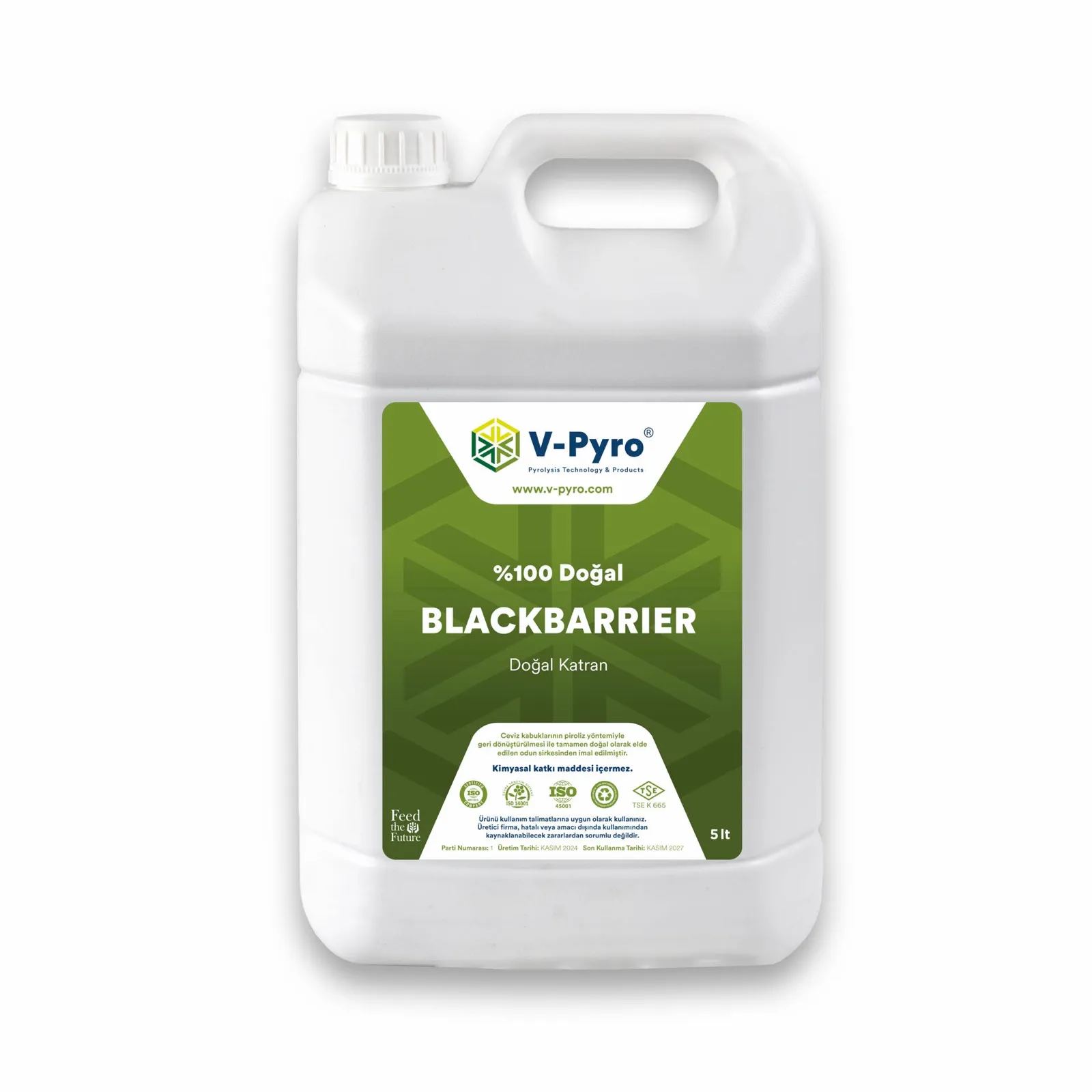 Industry
Wood Tar
Natural tar products for wood, metal and hull protection, graft and pruning wounds, and animal skin care.
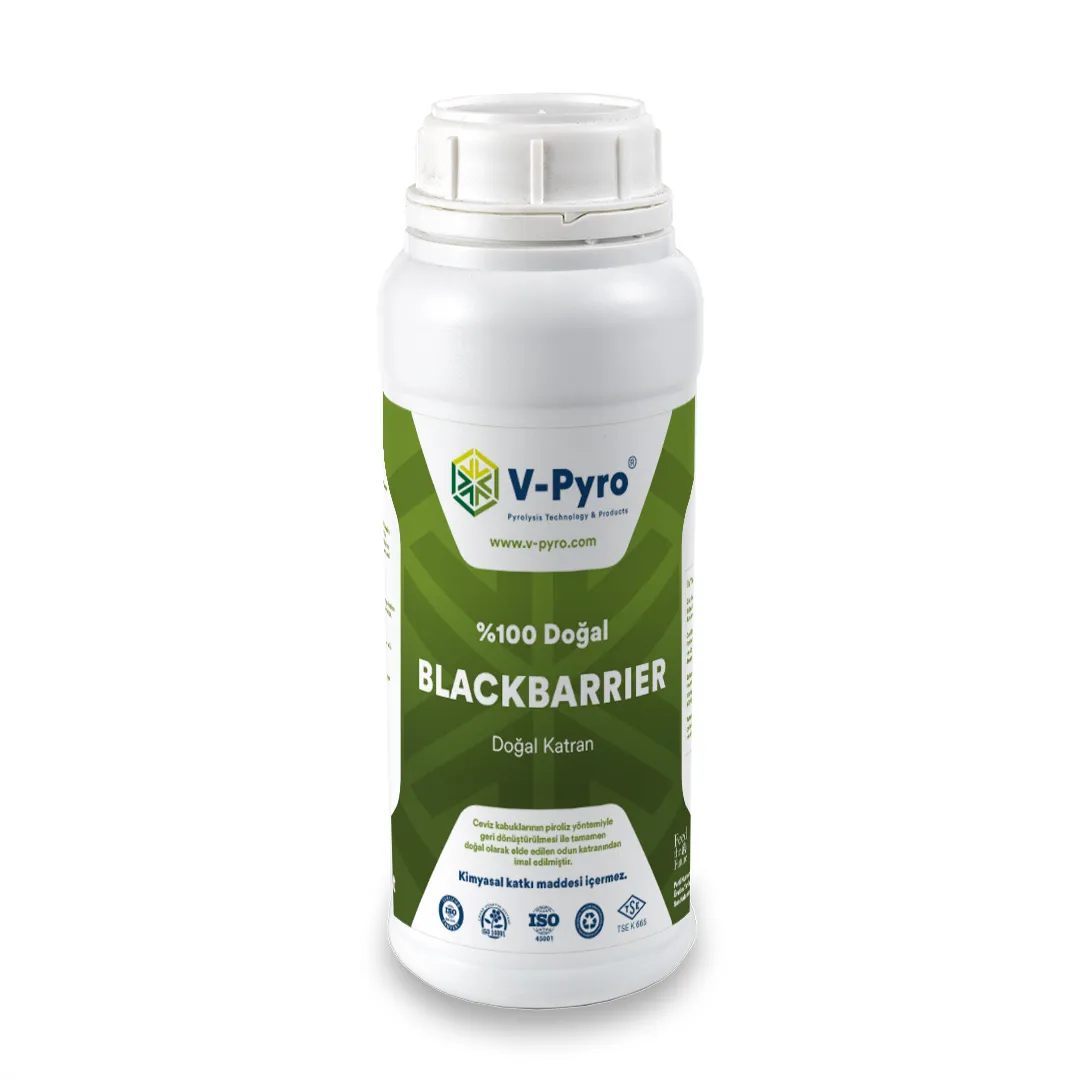 Industry
BLACKBARRIER
Water-repellent, anti-corrosion natural tar coating for wood and metal surfaces.
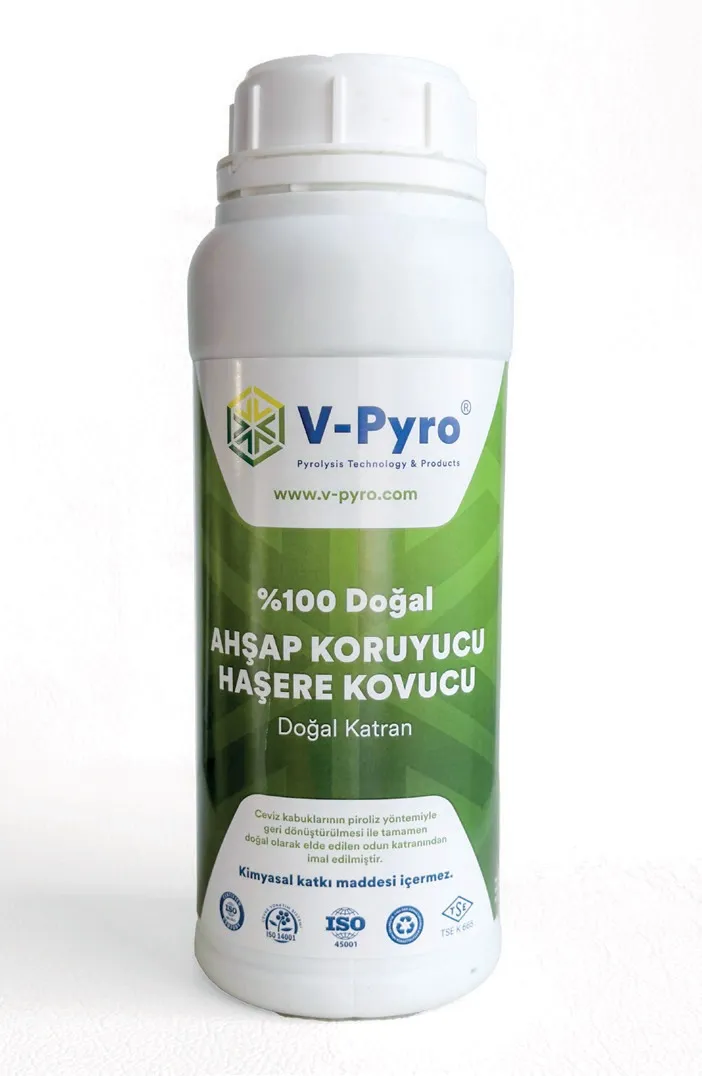 Industry
Wood Protector / Pest Repellent
Natural tar that protects wood against decay, fungi and wood-boring pests.
Application and rate by product.
| Product | Application | Rate | Frequency | Source |
|---|---|---|---|---|
| BLACKBARRIER | Wood surfacesFences, barns, vineyard houses, farm structuresProtection | Neat | Every 2–3 years | Manufacturer's recommendation |
| Metal surfacesTanks, profiles, farm machineryProtection | Neat | Annual inspection | Manufacturer's recommendation | |
| DilutionCan be diluted with solvent if necessaryProtection | 10–15% solvent | — | Manufacturer's recommendation | |
| Wood Protector / Pest Repellent | Wooden surfacesDepending on absorbency · at least 24 hours between coatsProtection | 1–2 coats | — | Manufacturer's recommendation |
These rates are general recommendations; details are on each product page's Dose–Effect tab.
Prepare the surface, apply, let it dry.
Full details on the product pages: BLACKBARRIER · Wood Protector / Pest Repellent.
Industrial application guidance
| Topic | Wood tar (general) | BLACKBARRIER | Wood Protector / Pest Repellent |
|---|---|---|---|
| Application area | Wood and metal protection, marine applications | Wood and metal surfaces; underwater hulls of boats, dinghies and fishing vessels | Wooden surfaces |
| Surface preparation | Clean the surface first | Surfaces must be clean and dry | Surface must be clean, dry and free of dust; remove old paint or varnish by sanding |
| Application method | Brush, spray or dipping | Brush, roller or spray | Brush, roller or dipping; 1–2 coats depending on the absorbency of the wood, at least 24 hours between coats |
| Dilution | Neat, or diluted with 10–20% solvent | If necessary, diluted with 10–15% solvent | — |
| Drying time | — | 24–72 hours depending on air circulation | At least 48 hours |
| Frequency | Once a year or as needed | Every 2–3 years on wood; annual inspection on metal | — |
Working safely with wood tar.
The signal word on the wood tar safety data sheet is Danger. Use personal protective equipment during application, and avoid skin contact and breathing the vapours. All hazard and precautionary statements are on the Application Protocol tab of the product pages and in the safety data sheet.
- Signal word
- Danger
- Toxicity · skin
- H301 · H311 · H314 · H317
- Inhalation · long-term
- H332 · H341 · H373
- Environment
- H412
Safety data sheet and analysis report.
Safety data sheet (SDS)
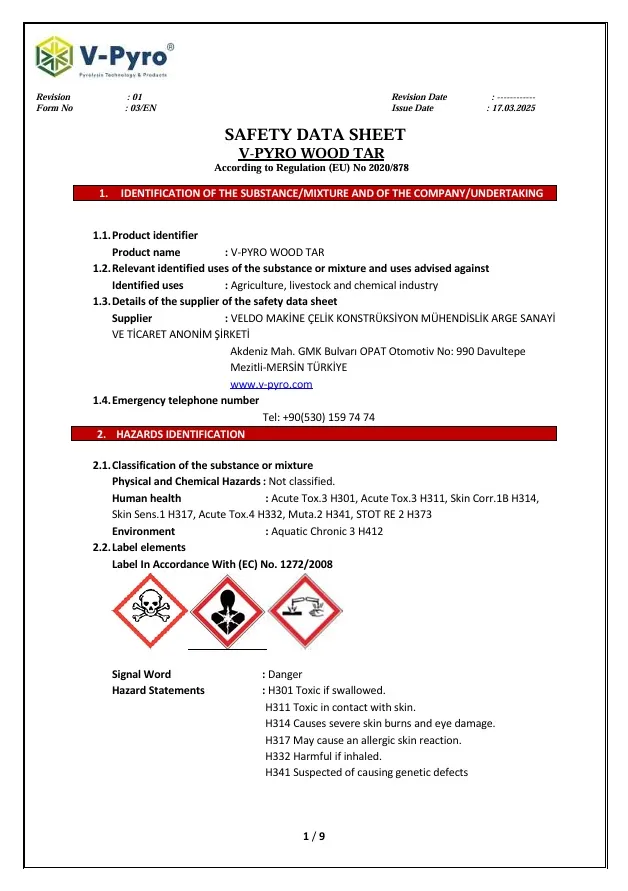 Enlarge document: V-Pyro Wood Tar safety data sheet, form no. 03/EN, first page (opens in a new tab)
Safety Data Sheet (SDS): V-Pyro Wood Tar
Prepared according to Regulation (EU) 2020/878 (English). Classification: Acute Tox. 3 (H301, H311), Skin Corr. 1B (H314), Skin Sens. 1 (H317), Acute Tox. 4 (H332), Muta. 2 (H341), STOT RE 2 (H373), Aquatic Chronic 3 (H412); pictograms GHS05, GHS06, GHS08; signal word: Danger.
Analysis report
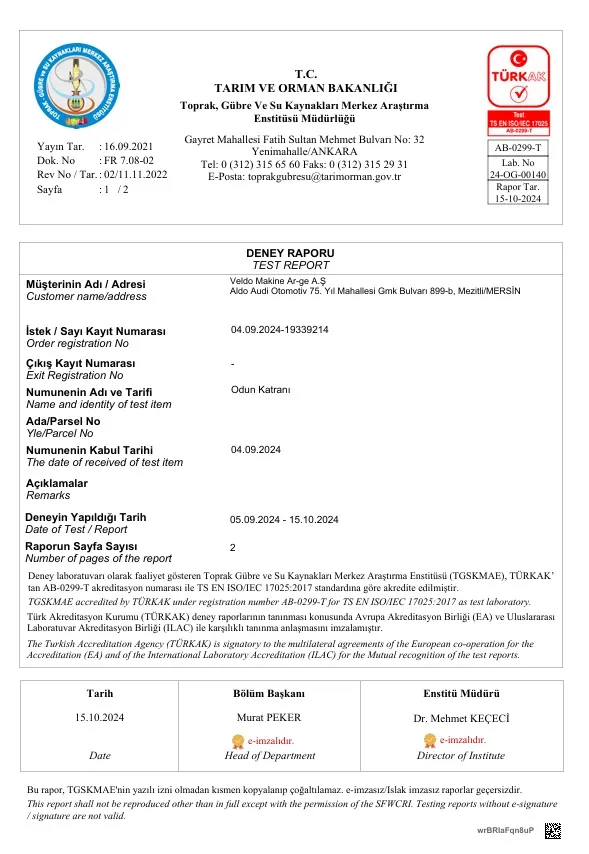 Enlarge document: TGSKMAE test report, laboratory no. 24-OG-00140, sample wood tar, cover page (opens in a new tab)
Test Report: wood tar
Plant and Organic Fertilizer Laboratory analyses; organic matter, nitrogen, phosphorus, nutrients and heavy metals.
Frequently asked questions about wood tar
What is wood tar and what is it used for?
Wood tar is one of the liquid by-products of the pyrolysis process. It is known for its antifungal and antiseptic properties and is traditionally used in wood preservation, veterinary care and non-pharmaceutical animal care.
Can it be used as a plant protection product?
Not directly. However, it may be included in some formulations as a natural pesticide or fungicide additive.
How is it used in animal care?
It can be applied topically as an antiseptic for hoof and skin problems. Licensed products must be used according to their instructions.
Is wood tar applied like paint?
Yes. It can be applied to wooden and metal surfaces with a brush or spray. Once dry, it forms a waterproof layer. Ideal for waste containers, poles and piers.
How long does tar last?
Depending on the surface and weather conditions, it can keep its protective effect for 2–5 years. It is resistant to salt water and is used in marine applications.
Can it be used as a grafting / pruning paste?
Yes. Tar-based natural pruning pastes in particular can be applied to tree cuts to keep out fungi and bacteria.
Is the tar smell permanent?
After the first application it has a natural, resin-like smell that fades over time. It is not as heavy or persistent as chemical paint odours.
Test it on your surfaces.
Request a sample or find your nearest authorised dealer.