
Carbon removal, carbon credits and afforestation
Pyrolysis turns the carbon in agricultural and forestry residues into a stable form. Added to the soil as biochar, this carbon can remain there for hundreds or even thousands of years.
How does biochar mitigate climate change?
Fossil fuels worsen global warming by returning carbon that was trapped in the earth for thousands of years to the atmosphere; they are carbon positive. As plants grow, they absorb carbon from the atmosphere through photosynthesis. At the end of their life cycle, however, this organic carbon is usually broken down by soil microbes and released back into the atmosphere.
When biochar is produced, the carbon is transformed into a more stable form that bacteria and fungi cannot easily break down. This prevents the carbon from returning to the atmosphere: biochar can remain stable in the soil for hundreds or even thousands of years.
According to a prominent study, widespread and sustainable application of biochar could offset up to 12% of annual anthropogenic greenhouse gas emissions (Woolf et al., 2010 (opens in a new tab)). Biochar production is therefore a carbon-negative technology that helps fight climate change by capturing carbon from the atmosphere and storing it in the soil.
In the soil, biochar retains moisture, absorbs nutrients and releases them slowly as plants need them, and gives microbes a natural habitat. Biochar products →
Product, dose and proof for your problem.
Permanent carbon storage in soil
Product
- Application dose
- Field crops: mixed into the soil before sowing, 100–200 kg/da · 1–5 kg per seedling or tree, into the planting hole or under the canopy
- Effect
- Turns carbon into a stable form that bacteria and fungi cannot easily break down; biochar can remain stable in soil for hundreds or even thousands of years
Afforestation on eroded and arid land
Product
- Application dose
- The cube is placed in the soil; the seed sprouts under suitable moisture and temperature · seed species chosen by season and region
- Effect
- Its biochar locks in carbon for the long term while the tree seed grows into a new sapling; over 90% sprouting and tree growth rate compared with conventional seeding
Carbon credits
Product
- Application dose
- Project-based · carbon credits are separate from the physical product
- Effect
- Partners who buy the credits can support their climate commitments with a traceable, auditable carbon solution
- Official proof
- Puro.Earth and EU Clean Carbon Registry pre-registration

Products for carbon and climate
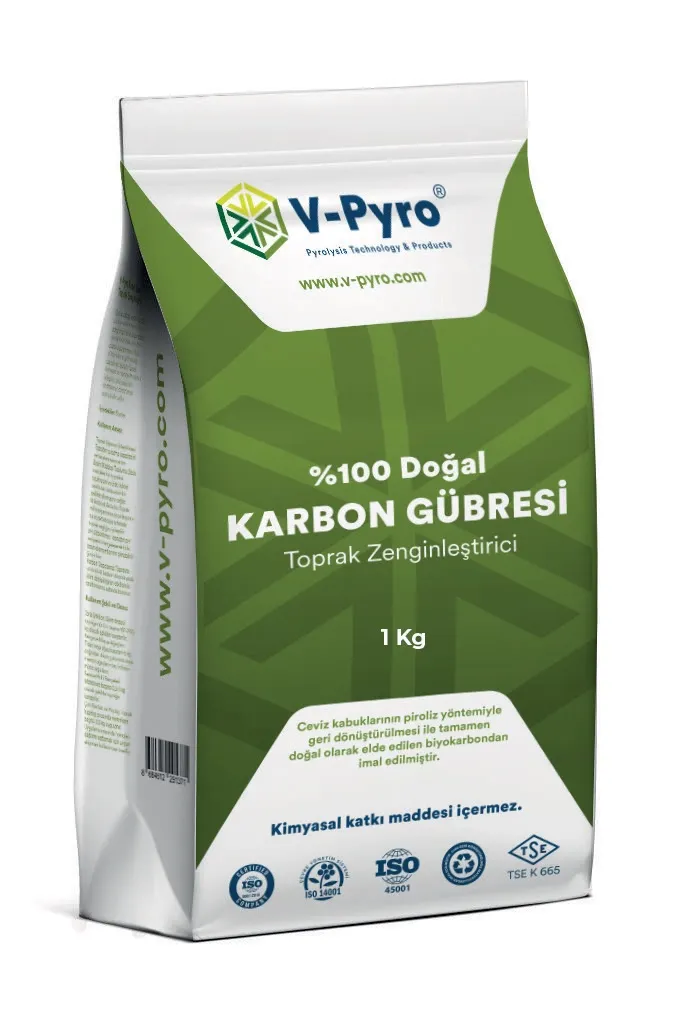
Application and rate by product.
| Product | Application | Rate | Frequency | Source |
|---|---|---|---|---|
| Carbon Fertilizer | Field cropsMixed into the soil before sowingSoil improvement | 100 – 200 kg/da | — | Manufacturer's recommendation |
| Gardens and fruit treesPer seedling or tree · into the planting hole or under the canopy of existing treesSoil improvement | 1 – 5 kg / tree | — | Manufacturer's recommendation | |
| Greenhouses and home gardensMixed into the soilSoil improvement | 0.5 – 1 kg/m² | — | Manufacturer's recommendation | |
| Lawns and landscapingApplied during soil preparationSoil improvement | 0.5 kg/m² | — | Manufacturer's recommendation |
These rates are general recommendations and do not replace a registered label or an agronomist's prescription. Details are on each product page's Dose–Effect tab.
Carbon credits are offered separately from our products.
V-Pyro verifies the carbon sequestration effect of the biochar it produces according to international standards and certifies it through the Puro.Earth platform. Carbon credits are separate from the physical product: buying biochar or Carbon Cubes does not mean buying carbon credits. Partners who purchase the credits separately can support their climate commitments. In this way we provide both a soil-enriching product and, for customers who request it, a traceable and auditable carbon solution.
- Platforms
- Puro.Earth · EU Clean Carbon Registry
- Registration status
- Pre-registration completed
- Next step
- Verification and audit, then certified carbon credits
- Our role
- Technology developer, field implementer, producer and system operator
Carbon Cube: carbon to the soil, trees to nature.
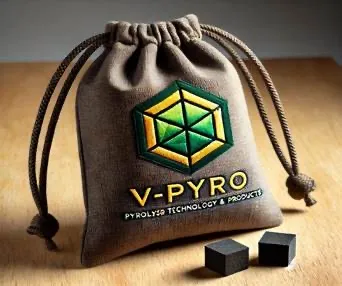
The Carbon Cube is an afforestation solution made of biochar obtained through pyrolysis and selected tree seeds. Once placed in the soil, the biochar provides long-term carbon sequestration while the seed sprouts under suitable moisture and temperature and grows into a new sapling. Carbon Cube →
1,500 carbon cubes in Anamur
We donated 1,500 carbon cubes to the Anamur Forestry Directorate for the rapid afforestation of areas at risk of erosion and landslides. The cubes help saplings take hold, increase water retention capacity and revitalise the soil.
250 cubes with our employees
Together with our employees we carried 250 carbon cubes to the field and placed them in nature. The activity strengthened team spirit and raised environmental awareness among our staff.
Sustainable Brands 2025 Biodiversity Award
For the project “Carbon Cubes: From Biomass Waste to Forest”, October 2025.
SÜT-D 2025 Low Carbon Hero Award
Received at the 10th Istanbul Carbon Summit hosted by Istanbul Technical University for our carbon-neutral production processes and the environmentally friendly products we obtain through pyrolysis, April 2025.
Biochar for municipalities and decision-makers.
With Türkiye's Climate Law, greenhouse gas reduction targets and preparations for a carbon market are on the agenda. A clear legal definition of biochar and supporting incentives would make it easier for farmers, municipalities and industry to take part in carbon removal.
In Europe, biochar is recognised as a soil improver. It is certified under international standards such as the EBC and IBI, and is widely used in organic farming and soil conditioning.
For municipalities, biochar means less irrigation, better soil structure and lower maintenance costs in parks, gardens and landscaped areas. It can be added to municipal composting facilities, and producing biochar from organic solid waste is a way to turn waste into a resource and reduce the carbon footprint.
Frequently asked questions about biochar
What is biochar and why should it be used?
Biochar is a high-carbon soil amendment obtained by carbonising agricultural waste through pyrolysis at 350–700°C in an oxygen-free environment. It increases water retention, balances soil pH and helps mitigate climate change through carbon sequestration.
What does biochar do in the soil?
It enhances microbial activity, reduces nutrient loss and improves water-holding capacity. It rehabilitates saline and barren soils and, over time, improves soil structure, thus increasing yield.
How much biochar should I apply?
Typically, 50–100 kg per decare (da) is applied. However, the amount may vary depending on soil type, crop and irrigation conditions. A soil analysis before application is recommended.
Can biochar be used together with traditional animal manure?
Yes. When mixed with manure, biochar retains the manure's nutrients, provides slow release and reduces bad odours. It also improves the composting process.
Is biochar truly beneficial for the environment?
Absolutely. Each tonne of biochar applied to the soil removes on average 2.5–3 tonnes of CO₂-equivalent carbon from the atmosphere for the long term, which lowers the carbon footprint of agriculture.
Does biochar reduce the need for irrigation?
Yes. Thanks to its porous structure, it retains water and keeps the root zone moist for longer, a significant advantage especially in arid regions.
Can biochar be used in organic farming?
Certified organic biochar can be used as a soil conditioner in organic production. It is important to buy from a certified producer.
Let's plan your project together.
Request a sample for corporate projects and afforestation partnerships, or find your nearest authorised dealer.