
Hygiene and surface disinfection
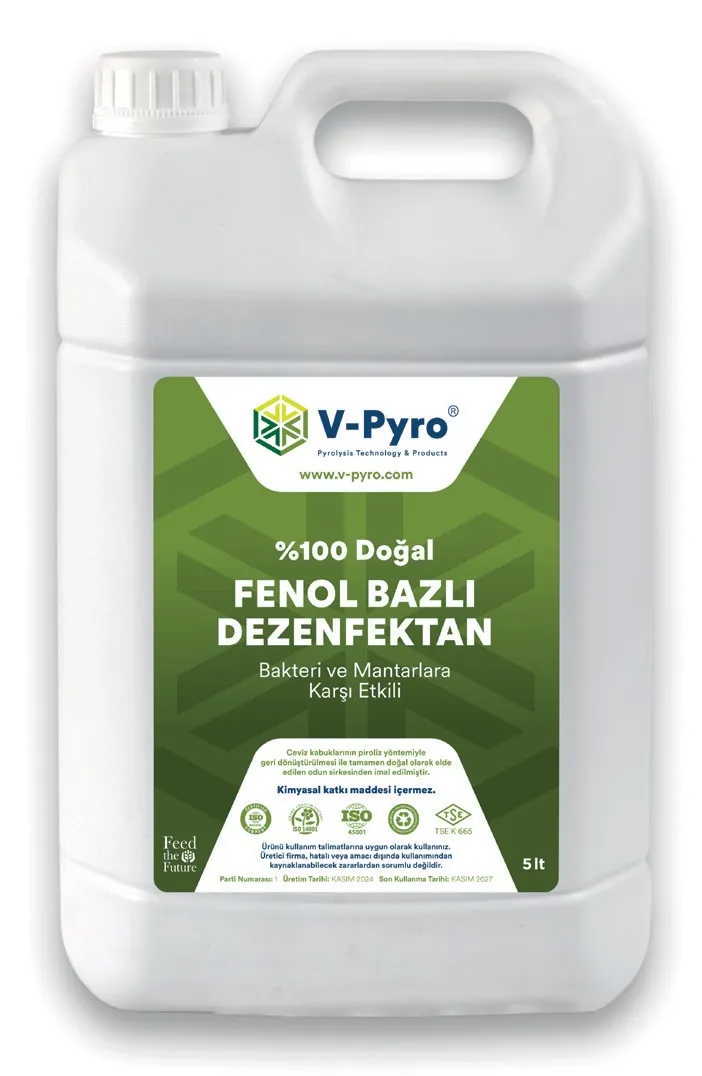
A natural alternative to synthetic disinfectants. Thanks to its phenolic compounds, pyroligneous acid (wood vinegar) provides surface hygiene, odour control and microbial suppression.
From waste containers to barns, pools and shared areas.
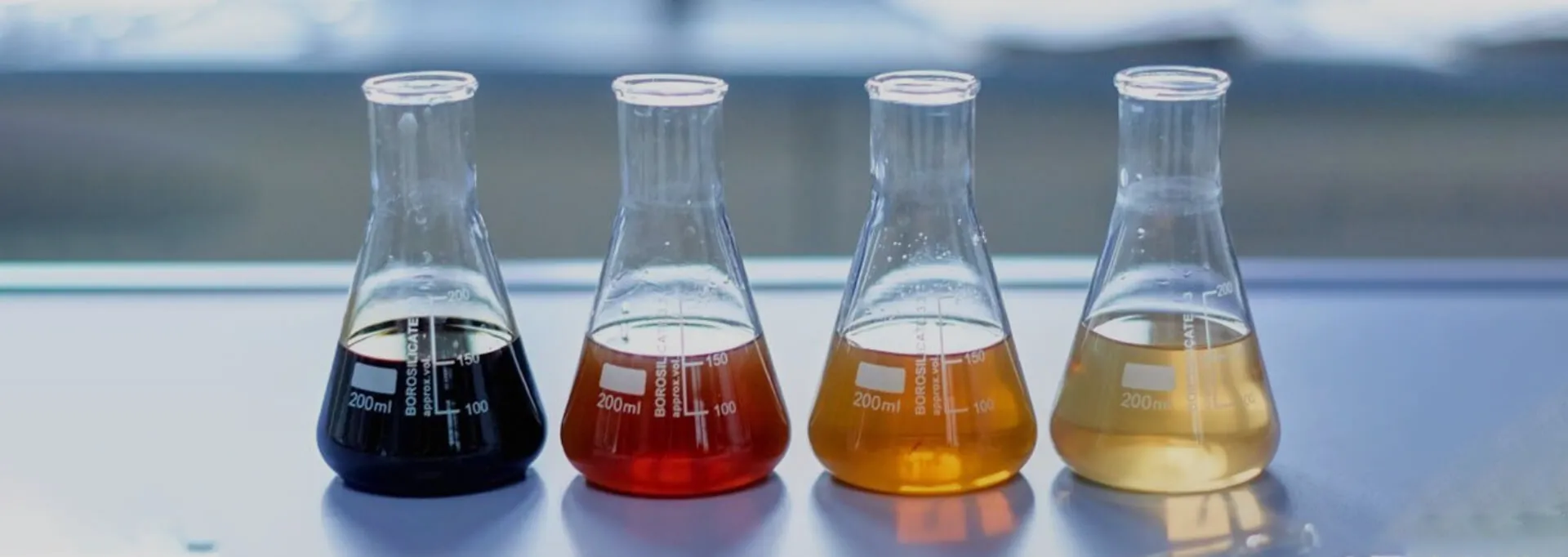
Wood vinegar contains phenols, acetic acid, methanol, aldehydes and esters. Phenolic compounds disrupt microbial cell membranes and render microorganisms inactive. This makes pyroligneous acid a natural, biodegradable disinfectant.
Municipal and waste management
Sprayed in diluted form in garbage containers, waste transfer stations, garbage trucks and container washing areas. It reduces pathogen load and controls odours; low-dose surface disinfection after daily cleaning slows biological decomposition.
Animal shelters and barns
In cattle and small-livestock shelters it suppresses bacteria and fungi on floors and walls, acts as an antiseptic that reduces the risk of disease transmission, suppresses ammonia odours and has a natural repellent effect on flies and parasites. Suitable for floors, feeders, water troughs and hoof baths.
Swimming pools and shared facilities
Thanks to its acetic acid and phenolic compounds it suppresses fungi and algae. In pools, showers and changing rooms it prevents bacterial growth between tiles and on floors, an environmentally friendly alternative to chemical disinfectants.
Other areas
Food businesses, hospitals, schools and other communal living spaces; public toilets and washrooms, veterinary clinics and pet grooming salons, campgrounds and mobile toilets, recycling facilities, sewers and drains. It deodorises and reduces microbial load, leaves a pleasant woody aroma and no harsh chemical residue.
Product, dose and proof for your problem.
Surface and shared-area disinfection
- Application dose
- 1:100 (≈ 1%) · 1:50 (≈ 2%) for heavy soiling · spray or wipe, no rinsing required
- Effect
- Prevents bacterial growth and suppresses fungi and algae in pools, showers and changing rooms
Waste containers and municipal vehicles
- Application dose
- 1:100 (≈ 1%) · 1:50 (≈ 2%) for heavy soiling · spray after daily cleaning
- Effect
- Reduces pathogen load, controls odour and slows biological decomposition
Animal shelter and barn hygiene
- Application dose
- 1:100 (≈ 1%) · 1:50 (≈ 2%) for heavy soiling · spray onto floors and walls
- Effect
- Suppresses bacteria and fungi in animal housing and reduces ammonia odours

Application and rate by product.
| Product | Application | Rate | Frequency | Source |
|---|---|---|---|---|
| Phenol-Based Natural Disinfectant | General disinfection1 litre of product mixed with 100 litres of water (≈ 1%)Disinfection | 1:100 | Daily or weekly as needed | Manufacturer's recommendation |
| Heavily soiled and contaminated areas1 litre of product mixed with 50 litres of water (≈ 2%)Disinfection | 1:50 | Daily or weekly as needed | Manufacturer's recommendation |
These rates are general recommendations; details are on each product page's Dose–Effect tab.
Dilute, apply, repeat.
Full protocol and safety information on the product page: Phenol-Based Natural Disinfectant.
- 01
Dilute
The dilution ratio typically ranges from 1:20 to 1:100. For general disinfection mix 1 litre of product with 100 litres of water (1:100); for heavily soiled and contaminated areas, 1 litre with 50 litres of water (1:50).
- 02
Apply
Apply the solution to surfaces with a spray, brush or simple sprayer, or wipe it on. No rinsing is required after application. Small tools and equipment can be disinfected by immersion.
- 03
Repeat
Apply daily or weekly as needed. The effect lasts longer on porous surfaces.
- 04
Protect yourself
Wear protective equipment, especially for large-scale applications. According to the safety data sheet the product causes skin irritation and serious eye irritation (H315, H319); after skin or eye contact, rinse with plenty of water.
Bactericidal and fungicidal tests in an accredited laboratory.
The results apply to the test conditions stated below.
Nanolab Laboratory Services (TÜRKAK AB-2023-T) · Pyroligneous acid (wood vinegar) · dirty conditions
| Standard | Test organism | Contact time | Result |
|---|---|---|---|
| TS EN 1276 · Bacteria | Staphylococcus aureus ATCC 6538 | 5 minutes | > 5 log reduction (over 99.999%) |
| TS EN 1276 · Bacteria | Pseudomonas aeruginosa ATCC 15442 | 5 minutes | > 5 log reduction (over 99.999%) |
| TS EN 1276 · Bacteria | Enterococcus hirae ATCC 10541 | 5 minutes | > 5 log reduction (over 99.999%) |
| TS EN 1276 · Bacteria | Escherichia coli ATCC 10536 | 5 minutes | > 5 log reduction (over 99.999%) |
| EN 1650 · Fungi | Candida albicans ATCC 10231 | 15 minutes | > 5 log reduction (over 99.999%) |
| EN 1650 · Fungi | Aspergillus brasiliensis ATCC 16404 | 15 minutes | > 5 log reduction (over 99.999%) |
| TS EN 1650 · Fungi | Aspergillus brasiliensis ATCC 16404 | 5 minutes | 4 log reduction (99.99%) |
Test reports and safety data sheet.
Test report
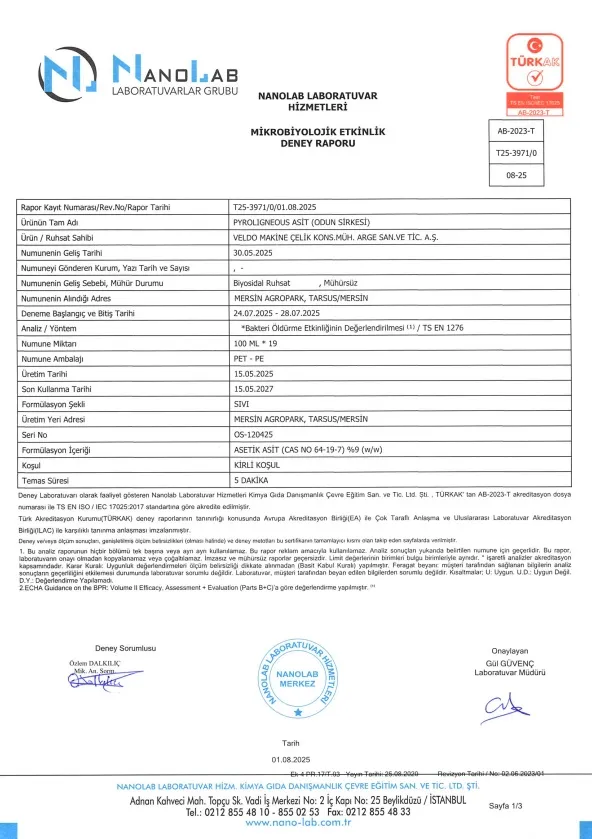 Enlarge document: Nanolab microbiological efficacy test report T25-3971/0 for pyroligneous acid, TS EN 1276, first page (opens in a new tab)
Microbiological Efficacy Test Report: bactericidal activity (TS EN 1276)
Pyroligneous acid (wood vinegar), lot OS-120425, 9% (w/w) acetic acid; dirty conditions, 5-minute contact time. At an 80% test concentration: >5 log (over 99.999%) reduction of Staphylococcus aureus ATCC 6538, Pseudomonas aeruginosa ATCC 15442, Enterococcus hirae ATCC 10541 and Escherichia coli ATCC 10536.
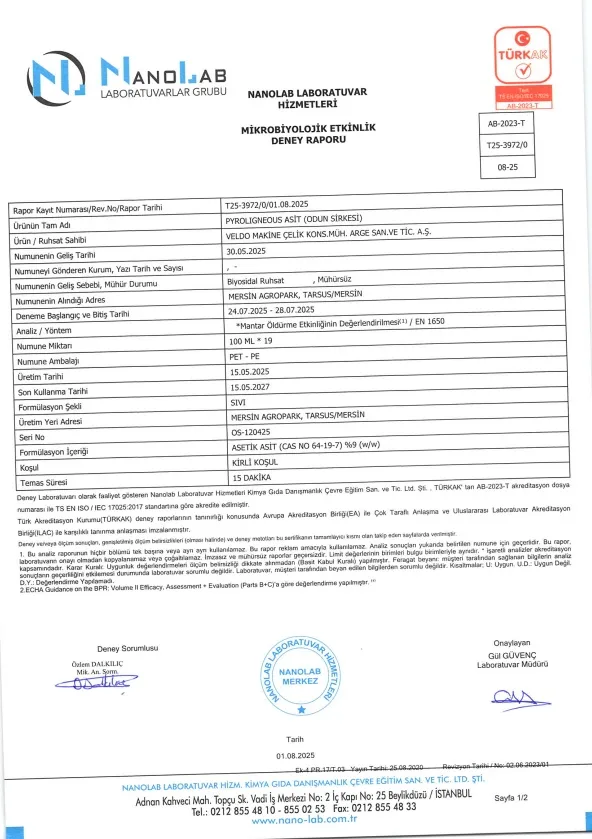 Enlarge document: Nanolab microbiological efficacy test report T25-3972/0 for pyroligneous acid, EN 1650, first page (opens in a new tab)
Microbiological Efficacy Test Report: fungicidal activity (EN 1650)
Pyroligneous acid (wood vinegar), lot OS-120425, 9% (w/w) acetic acid; dirty conditions, 15-minute contact time. At an 80% test concentration: >5 log (over 99.999%) reduction of Candida albicans ATCC 10231 and Aspergillus brasiliensis ATCC 16404.
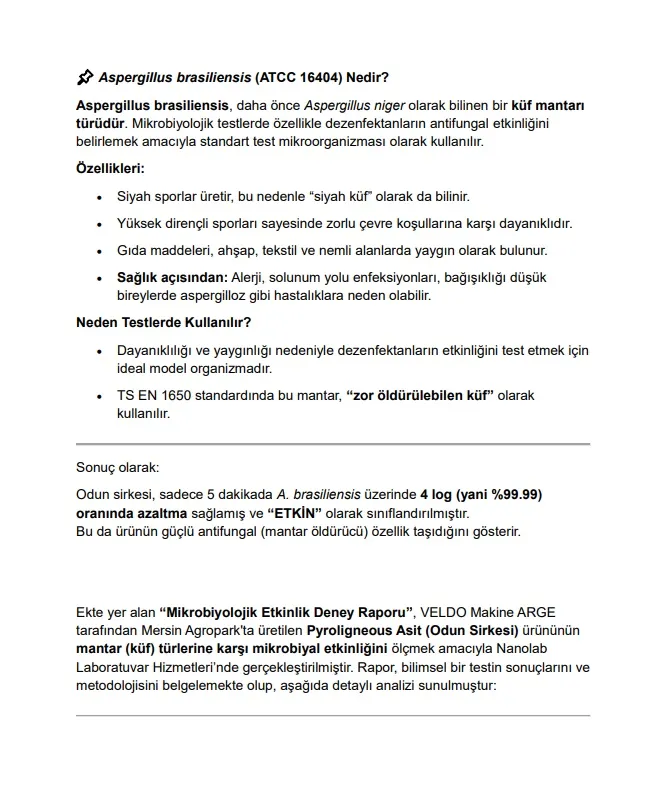 Enlarge document: V-Pyro explanatory sheet in Turkish on Aspergillus brasiliensis (ATCC 16404) and the TS EN 1650 test (opens in a new tab)
V-Pyro summary: fungicidal activity against Aspergillus brasiliensis (TS EN 1650; Nanolab report T25-3459/0, 22 July 2025)
V-Pyro summary of Nanolab report T25-3459/0: pyroligneous acid with 9% (w/w) acetic acid achieved a 4 log (99.99%) reduction of Aspergillus brasiliensis ATCC 16404 in 5 minutes under dirty conditions and was classified as “EFFECTIVE”.
Safety data sheet (SDS)
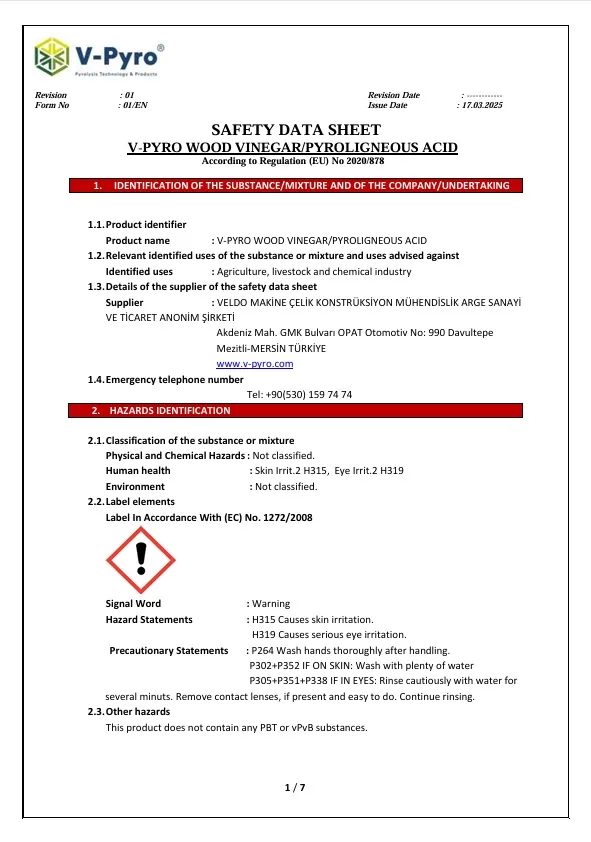 Enlarge document: V-Pyro Wood Vinegar / Pyroligneous Acid safety data sheet, form no. 01/EN, first page (opens in a new tab)
Safety Data Sheet (SDS): V-Pyro Wood Vinegar / Pyroligneous Acid
Prepared according to Regulation (EU) 2020/878 (English). Classification: Skin Irrit. 2 (H315), Eye Irrit. 2 (H319); pictogram GHS07; signal word: Warning. Contains no PBT or vPvB substances.
Frequently asked questions about wood vinegar
What is wood vinegar?
It is a liquid obtained by condensing the smoke released during the pyrolysis of organic agricultural waste. It contains acetic acid, phenols, ketones, esters and alcohols, and is used as a natural microbial balancer and antifungal agent.
How is it applied to plants?
It is generally diluted at a ratio of 1:100 (1 litre of wood vinegar + 100 litres of water) and applied as a foliar spray or through drip irrigation. Positive effects have been observed on crops such as tomatoes, peppers and lettuce.
Is wood vinegar harmful to human health?
It is natural in content but can be irritating at high concentrations. It should be diluted before use, and direct contact should be avoided. Certified organic versions are available.
Can it be used in animal feed?
Yes, especially to support the immune system. However, only products licensed as “animal feed additives” should be used, in a controlled way.
Wood vinegar is not a pesticide, so what does it do?
It is a natural microbial balancer in agriculture. It reduces the use of chemical pesticides, strengthens plant immunity and promotes growth.
Can wood vinegar be used as a disinfectant?
Yes. Thanks to its natural phenolic content, it suppresses harmful microorganisms and prevents bad odours in areas such as waste containers, animal shelters and barn floors.
Can it be used to wash fruit and vegetables?
Appropriately diluted wood vinegar (1:200) helps remove pesticide residues from fruit and vegetables. Rinse thoroughly with water before consumption.
Can wood vinegar be mixed with other fertilisers?
Yes. It has a synergistic effect when mixed with compost, liquid fertilisers, seaweed extracts or humic acids. Follow the application dose carefully.
Try it at your facility.
Request a sample or find your nearest authorised dealer.