

Agriculture and soil
Biochar
A plant-based soil amendment made from agricultural waste such as olive pits, walnut shells and apricot kernels. It retains moisture and nutrients, provides a habitat for microbes and keeps carbon stable in the soil for hundreds or even thousands of years.
- 150–500kg/da, depending on the crop group
- 2–6 yearsReapplication interval
- 96.37%Organic matter · TGSKMAE analysis
What is Biochar?
Biochar is a plant-based soil amendment made by pyrolysis from agricultural waste such as olive pits, walnut shells and apricot kernels. It retains moisture and nutrients, gives microbes a habitat and keeps carbon stable in the soil for hundreds or even thousands of years. V-Pyro's biochar products are used for field, garden and greenhouse soils, animal feed and afforestation.
Less water, more nutrients, livelier soil.
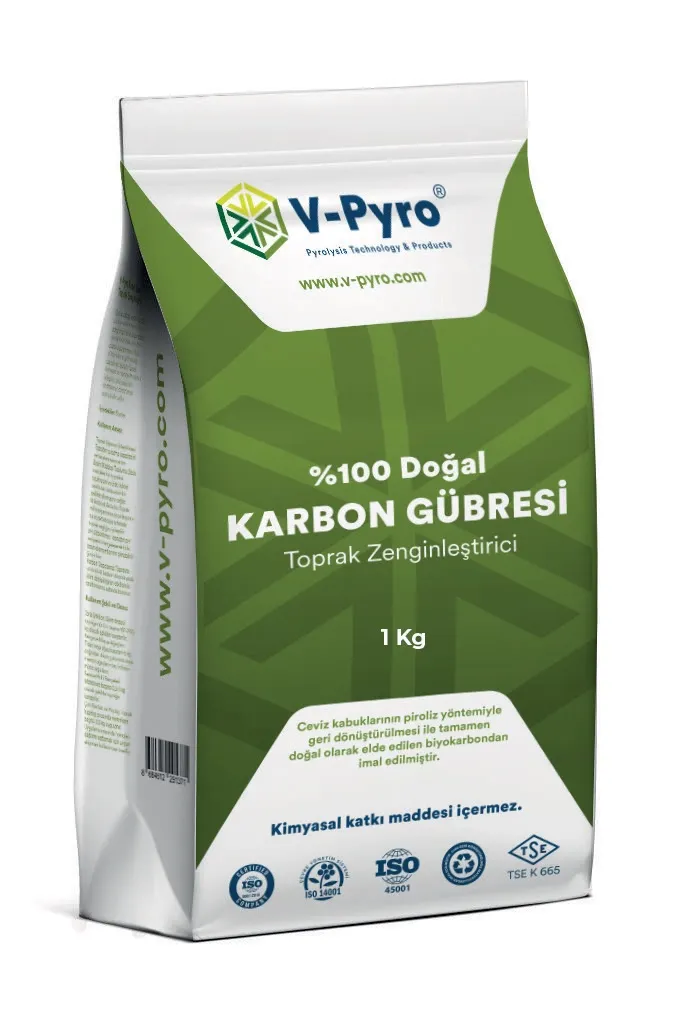
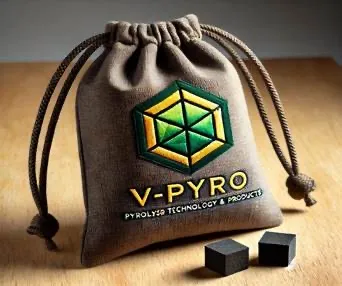
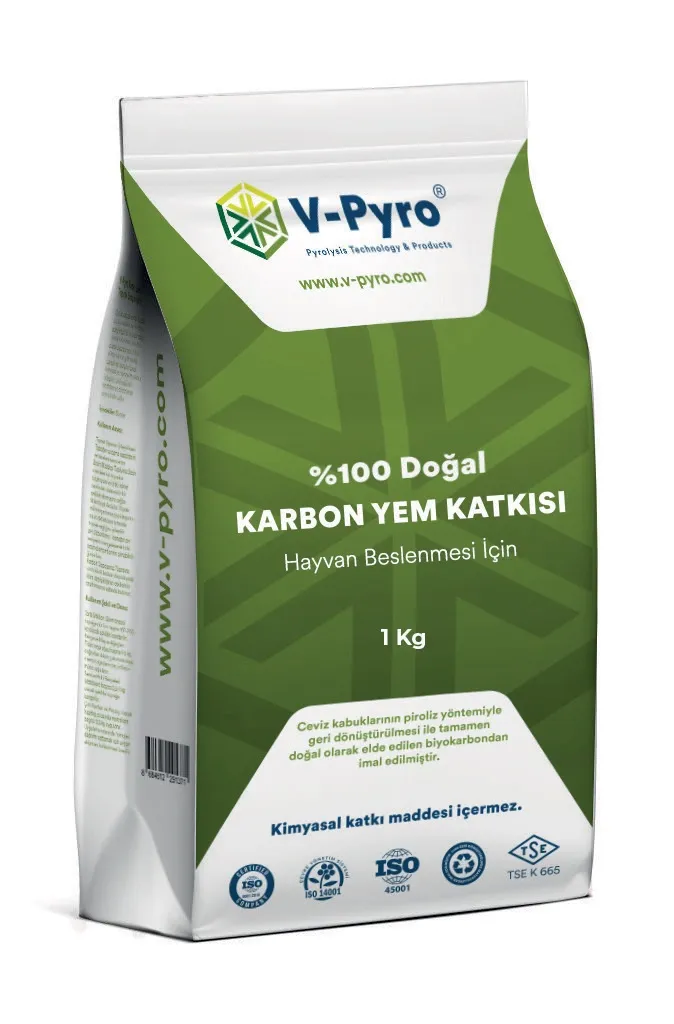
The V-Pyro biochar family has three products: Carbon Fertilizer for field, garden and greenhouse soils, KARBOVITAL for animal feed and the Carbon Cube for afforestation.
Uses less water
Retains moisture and helps plants withstand dry periods; increases the soil's ability to hold water.
Better nutrient retention
Absorbs nutrients and slowly releases them as plants need them; makes fertilisers more effective and improves plant nutrition.
More microbial activity
Provides a natural habitat for the microbes that turn organic matter into nutrients; boosts soil microorganism diversity and activity.
Improves soil structure
Enhances aeration and drainage, encouraging deeper and stronger root growth.
pH regulation
Balances soil pH to create a suitable environment for plant growth.
Carbon storage
Improves environmental sustainability by storing carbon in the soil over the long term.
It locks carbon into a stable form and keeps it in the soil.
As plants grow, they absorb carbon from the atmosphere through photosynthesis; at the end of their life cycle this organic carbon is usually broken down by soil microbes and released back into the atmosphere. When biochar is produced, the carbon is transformed into a more stable form that bacteria and fungi cannot easily break down; it does not return to the atmosphere and can remain stable in the soil for hundreds or even thousands of years. According to a prominent study, widespread and sustainable use of biochar could offset up to 12% of annual human-caused greenhouse gas emissions. Biochar production is therefore a carbon-negative technology that takes carbon from the atmosphere and locks it into the soil. The product's carbon sequestration effect has been verified according to international standards; carbon credits are separate from the physical product. More: Carbon & Climate.
- Organic matter
- 96.37%
- pH
- 7.44
- Carbon (SDS)
- >80%
- Permanence
- Hundreds of years
Biochar analysis results · TGSKMAE test report, lab no. 24-OG-00141 (15 Oct 2024)
| Analysis | Method | Result |
|---|---|---|
| Moisture (%) | A.O.A.C. 1995 | 4.35 |
| Organic matter (%) * | TL 7.02.32 (Rev.4) (AOAC 967.03, 04, 05) | 96.37 |
| pH | 1/10 potentiometric | 7.44 |
| Total phosphorus pentoxide (P₂O₅) (ppm) | ICP | 634.33 |
| Water-soluble potassium oxide (K₂O) (%) | GPGDY Annex 3/4.1 | 0.21 |
| Total tin (Sn) (ppm) | GPGDY Annex 2 9.1/10.1 | 307.0 |
| Total nitrogen, Kjeldahl (%) * | TL 7.02-02 (Rev.4) TS EN 15478 | 0.30 |
| Total cadmium (Cd) (ppm) | GPGDY Annex 2 9.1/10.1 | Below detection limit |
| Total cobalt (Co) (ppm) | GPGDY Annex 2 9.1/10.1 | 2.0 |
| Total chromium (Cr) (ppm) | GPGDY Annex 2 9.1/10.1 | 14.0 |
| Total nickel (Ni) (ppm) | GPGDY Annex 2 9.1/10.1 | 5.0 |
| Total lead (Pb) (ppm) | GPGDY Annex 2 9.1/10.1 | Below detection limit |
150–500 kg per decare, depending on the crop group.
The amount, application depth, timing and reapplication interval depend on the crop group.
| Application | Rate | Frequency | Source |
|---|---|---|---|
| Field cropsCorn, wheat, cotton, etc. · during soil preparation before sowingSoil improvement | 200 – 300 kg/da | Every 3–5 years | Manufacturer's recommendation |
| VegetablesTomato, pepper, cucumber, etc. · before transplanting seedlingsSoil improvement | 250 – 350 kg/da | Every 2–3 years | Manufacturer's recommendation |
| Fruit treesApple, peach, citrus, etc. · before planting and in early springSoil improvement | 300 – 500 kg/da | Every 4–6 years | Manufacturer's recommendation |
| VinesGrapes, kiwi, etc. · before planting and in early springSoil improvement | 250 – 400 kg/da | Every 3–5 years | Manufacturer's recommendation |
| Ornamental plants and flowersBefore planting or repottingSoil improvement | 150 – 250 kg/da | Every 2–3 years | Manufacturer's recommendation |
Recommended application methods
| Crop group | Amount (kg/da) | Depth (cm) | Timing | Reapplication interval |
|---|---|---|---|---|
| Field crops (corn, wheat, cotton, etc.) | 200–300 | 10–15 | During soil preparation before sowing | Every 3–5 years |
| Vegetables (tomato, pepper, cucumber, etc.) | 250–350 | 10–20 | Before transplanting seedlings | Every 2–3 years |
| Fruit trees (apple, peach, citrus, etc.) | 300–500 | 20–30 | Before planting and in early spring | Every 4–6 years |
| Vines (grapes, kiwi, etc.) | 250–400 | 15–25 | Before planting and in early spring | Every 3–5 years |
| Ornamental plants and flowers | 150–250 | 5–15 | Before planting or repotting | Every 2–3 years |
These rates are general recommendations, not a licensed label or an agronomist's prescription. Consult our technical team about your soil and try them on a small plot first.
Mix into the soil before planting; renew every 2–6 years.
- 01
Set the amount
150–500 kg per decare depending on the crop group; see the Dose–Effect tab.
- 02
Choose the timing
Apply during soil preparation before sowing or planting; early spring also suits fruit trees and vines, and repotting suits ornamentals.
- 03
Mix into the soil
Work it in to a depth of 5–30 cm depending on the crop group.
- 04
Renew
Repeat the application every 2–6 years depending on the crop group.
Safety information
- Signal word
- Warning
- Hazard statements
- H319 · Causes serious eye irritation.
- H335 · May cause respiratory irritation.
- Precautionary statements
- P264 · Wash hands thoroughly after handling.
- P271 · Use only outdoors or in a well-ventilated area.
- P304+P340 · IF INHALED: Remove person to fresh air and keep comfortable for breathing.
- P305+P351+P338 · IF IN EYES: Rinse cautiously with water for several minutes. Remove contact lenses, if present and easy to do. Continue rinsing.
- P312 · Call a poison centre or doctor if you feel unwell.
- P501 · Dispose of contents/container in accordance with national regulations.
Common questions
What is biochar and why should it be used?
Biochar is a high-carbon soil amendment obtained by carbonising agricultural waste through pyrolysis at 350–700°C in an oxygen-free environment. It increases water retention, balances soil pH and helps mitigate climate change through carbon sequestration.
What does biochar do in the soil?
It enhances microbial activity, reduces nutrient loss and improves water-holding capacity. It rehabilitates saline and barren soils and, over time, improves soil structure, thus increasing yield.
How much biochar should I apply?
Typically, 50–100 kg per decare (da) is applied. However, the amount may vary depending on soil type, crop and irrigation conditions. A soil analysis before application is recommended.
Can biochar be used together with traditional animal manure?
Yes. When mixed with manure, biochar retains the manure's nutrients, provides slow release and reduces bad odours. It also improves the composting process.
Is biochar truly beneficial for the environment?
Absolutely. Each tonne of biochar applied to the soil removes on average 2.5–3 tonnes of CO₂-equivalent carbon from the atmosphere for the long term, which lowers the carbon footprint of agriculture.
Does biochar reduce the need for irrigation?
Yes. Thanks to its porous structure, it retains water and keeps the root zone moist for longer, a significant advantage especially in arid regions.
Can biochar be used in organic farming?
Certified organic biochar can be used as a soil conditioner in organic production. It is important to buy from a certified producer.
Try it in the field.
Request a sample or find your nearest authorised dealer.