
Pyrolysis technology
Pyrolysis is the thermal decomposition of biomass without oxygen. Agricultural waste does not burn; it splits into three product phases: solid, liquid and heavy fraction.
Breaking down without burning.
Pyrolysis is the decomposition of organic matter by heating it without oxygen; the name comes from the Greek words for “fire” (pyr) and “loosening” (lysis). With no oxygen present, the material does not burn. The heat breaks the large molecules that make up biomass, such as cellulose, hemicellulose and lignin, into smaller fragments, which separate into gas, liquid and solid products.
When biomass is burned, most of its carbon escapes into the air as carbon dioxide. In pyrolysis, a large share of the carbon stays in a stable solid called biochar. Temperature, heating time and the type of feedstock determine how much of each product is formed and what its properties are. How biochar relates to the climate: Carbon & Climate.
Our R&D work on reactor design is documented by the project “Reactor Design for Plant and Plastic Waste Recycling” (30 November 2021 – 17 July 2023), approved by the Turkish Ministry of Industry and Technology. Our R&D work →
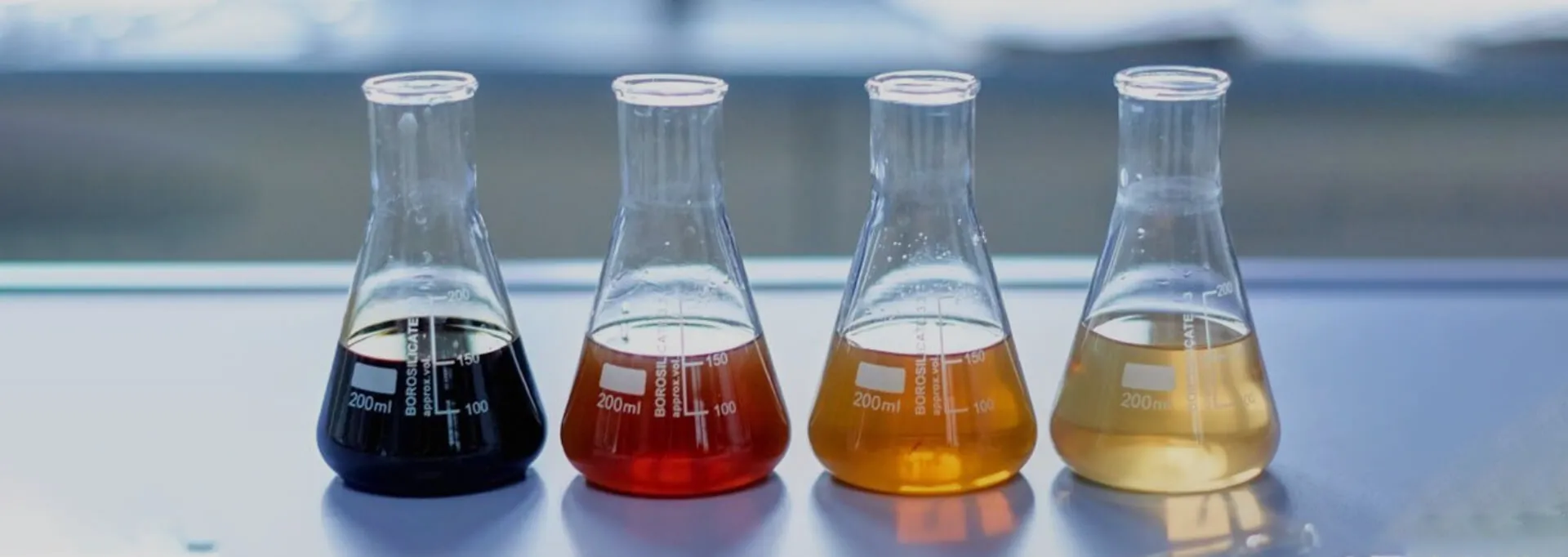
From feedstock to three product phases.
- 01
Feedstock
Agricultural waste such as olive pits, walnut shells and apricot kernels is collected and dried at our plant.
- 02
Pyrolysis
The dry feedstock is heated in the reactor without oxygen at 700°C. Without oxygen there is no combustion; the biomass breaks down under heat.
- 03
Condensing and separating
The vapour leaving the reactor is cooled and condensed: the watery liquid phase forms pyroligneous acid (wood vinegar) and the dark, viscous heavy fraction forms wood tar. When pyrolysis is complete, biochar remains in the reactor.
Each phase, its own product family.
Solid phase: Biochar
The carbon-rich, porous solid left in the reactor. Used as a soil amendment, a carbon feed additive and the seeded Carbon Cube.
Liquid phase: Pyroligneous Acid
Also known as wood vinegar; contains organic compounds such as acetic acid, phenols and ketones. The basis of our plant growth, nutrition, pH regulation, feed additive and hygiene products.
Heavy fraction: Wood Tar
A dark, viscous organic tar rich in hydrocarbons, acids and phenols. Used for wood and metal protection, graft and pruning wounds and animal skin care.
All three phases were analysed in the laboratory.
The biochar values come from test report 24-OG-00141 (15 October 2024) of the Ministry of Agriculture and Forestry's Soil, Fertilizer and Water Resources Central Research Institute and from the biochar safety data sheet. Wood vinegar was analysed at MEİTAM against the TSE K 665 criteria (MEÜ.MR.1124/006, 15 November 2024); the wood tar analysis is in the same institute's report 24-OG-00140 (15 October 2024). Our standards: TSE K 665 for wood vinegar, TSE K 683 for organic wood tar and TSE K 684 for biochar. Reports: Tests / Licences / TSE →
- Biochar · organic matter
- 96.37%
- Biochar · pH
- 7.44
- Biochar · carbon (SDS)
- >80%
- Biochar · criteria
- TSE K 684
- Wood vinegar · criteria
- TSE K 665
- Wood tar · criteria
- TSE K 683
Watch pyrolysis at work.
More videos are in the Video Centre. All videos →
How Does Pyrolysis Work?
A short video (in Turkish) that uses a small demo kit to show, step by step, how pyrolysis recycles organic waste. As the waste is heated without oxygen it releases water vapour, then a hydrogen-rich gas, wood tar and wood vinegar; when pyrolysis is complete, solid carbon (biochar) is left behind.
Try the three product phases in the field.
Request a sample or find your nearest authorised dealer.