
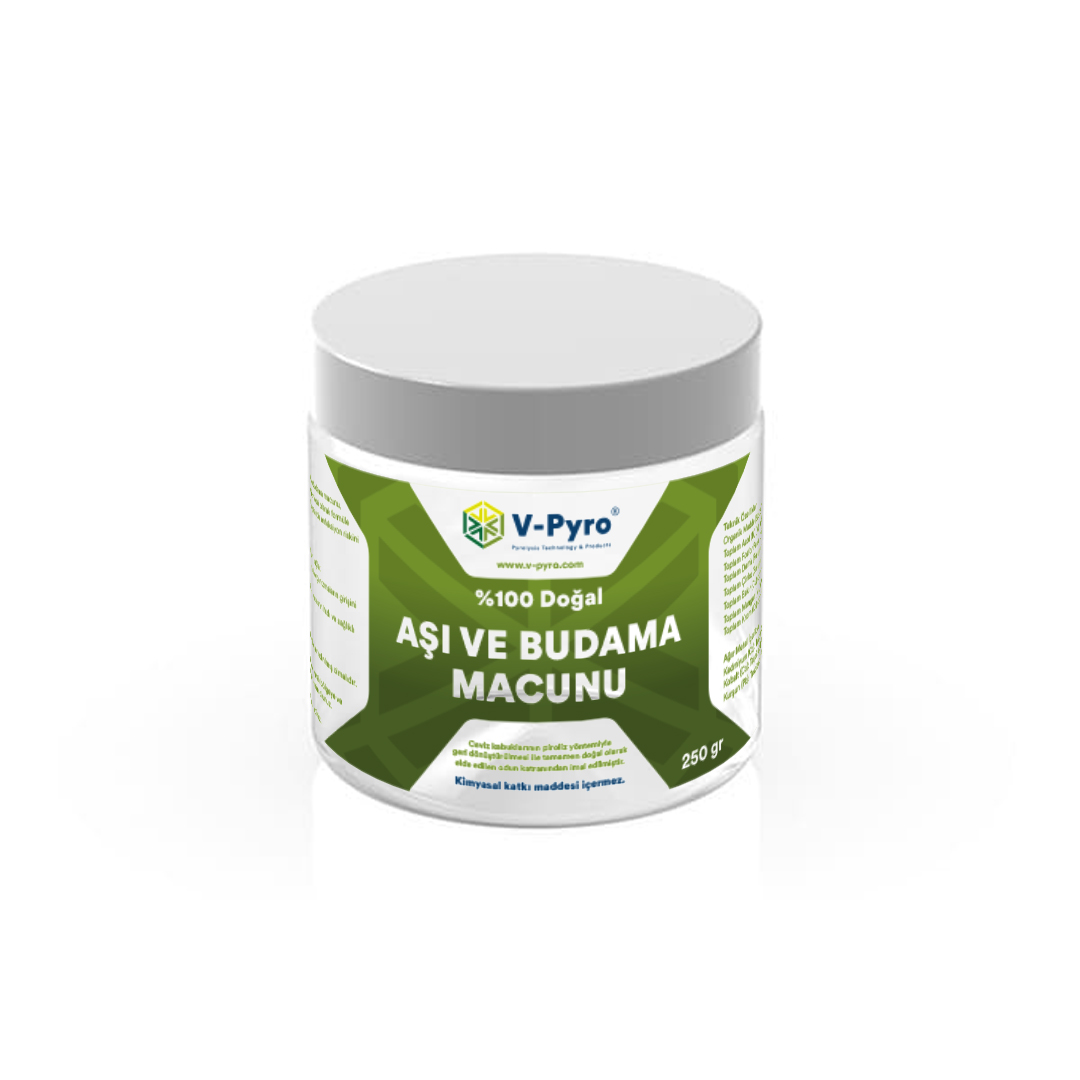
V-PYRO Grafting/Pruning Paste 250 gr
250 Gr
₺ 700,00
Select Size
250 GrV-PYRO GRAFTING & PRUNING PASTE
Product Description:
V-PYRO Wood Tar is a thick, natural product obtained from the slow pyrolysis of lignocellulosic agricultural waste (such as olive pits, walnut shells, etc.). It contains natural antiseptic, antifungal, and water-resistant compounds. Thanks to these properties, it is used to seal grafting sites and pruning cuts on trees.
Composition (Qualitative & Quantitative Structure):
| Component | Ratio (%) | Function |
|---|---|---|
| Phenolic Compounds (Phenol, Cresol, Guaiacol) | 1 – 4% | Antiseptic and antifungal effect |
| Aromatic Hydrocarbons | 2 – 6% | Surface protection and water resistance |
| Resinous Components | 10 – 20% | Forms a physical barrier |
| Carbon-rich oil phase (after water evaporation) | 60 – 80% | Carrier and protective matrix |
Note: This product is in pure form and contains no additives. It is plant-based and free from synthetic chemical agents.
Purpose and Effects:
- Prevents drying of the grafting site
- Provides physical and chemical protection against bacteria, fungi, and harmful microorganisms
- Blocks insects and external factors from entering wound surfaces
- Reduces water loss by isolating the wound surface from the external environment
- Improves graft take rates and accelerates recovery after pruning
- Insulates the surface from air and moisture
Application Method and Timing:
- For Grafting: Immediately after grafting, apply a thin layer of tar over the grafting site.
- For Pruning: After pruning, apply the paste to the cut surface using a brush or spatula.
- Timing: Application should be done while the plant is dormant or in early spring.
- Frequency: One application is usually sufficient. Reapply if there is heavy rainfall.
Precautions:
- The tar should be used at room temperature in a semi-fluid state.
- Avoid application during freezing or excessively hot weather.
- On fruit trees intended for food production, apply only to the trunk or permanent structural parts.
Scientific Basis:
The antiseptic and antifungal effects of tar are due to its phenolic compounds. Phenol and its derivatives cause damage to microbial cell walls, providing disinfection (Melo et al., 2014). In traditional forestry and fruit growing, natural resins and tars have been used for centuries to seal pruning wounds. Recent studies have shown that plant-based pyrolytic tars offer longer-lasting protection compared to synthetic pastes (Yoshimoto & Hata, 2019).